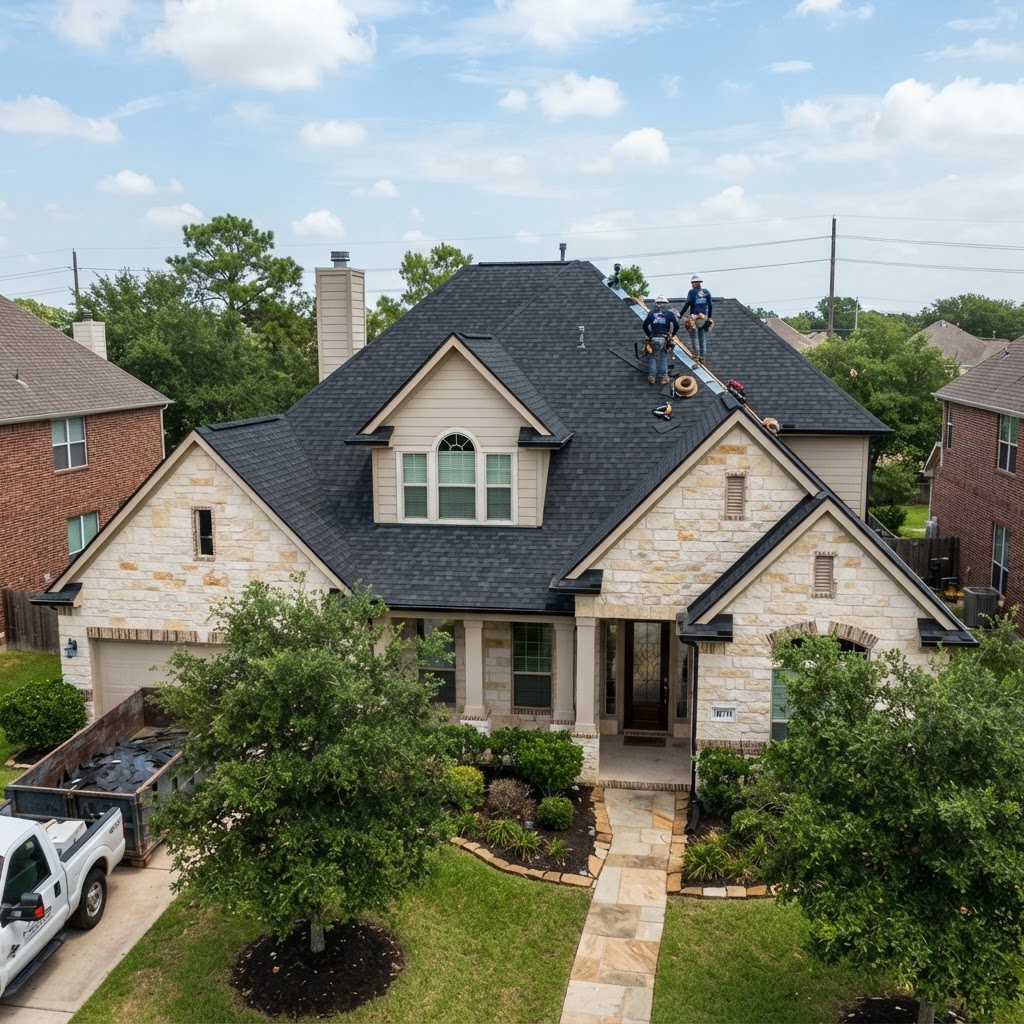
Magnolia Roof Replacement After Storm Damage: Honest Cost Breakdown and What Actually Moves the Price
If you're a Magnolia homeowner staring at storm damage and wondering what a roof replacement really costs — not the vague ranges you find online — this is the breakdown you've been looking for. Real numbers, real variables, and zero fluff.
What Magnolia Homeowners Are Actually Dealing With
Montgomery County sits in one of the most meteorologically aggressive zip codes in North America. That's not marketing language — it's what the hail maps show year after year. Magnolia specifically gets hammered by pop-up supercells that spin off the Gulf moisture corridor, often producing 1.5" to 2.5" hail with almost no warning. The April 2024 storm that tracked through 249 and FM 1488 left a trail of punctured decking and cracked ridge caps on roofs that were only 8–10 years old. We've been on those roofs.
Beyond hail, Magnolia homeowners face a compounding problem: the clay-heavy soils in this area shift seasonally, which stresses the flashing at your chimney, pipe boots, and eave transitions. Then you add 95°F summers with UV indexes that degrade standard 3-tab shingles at nearly twice the rate you'd see in, say, Colorado. What this means practically is that storm damage in Magnolia rarely occurs on a roof that was otherwise pristine — it usually exposes latent issues that were already brewing.
So when you're getting quotes after a storm, the price spread you see (sometimes $8,000 to $22,000 on the same house) isn't just contractor markup games. A lot of it is real scope variation. Let's break that down.
The Baseline: What a Typical Magnolia Roof Replacement Costs
For a standard single-story home in Magnolia — 2,000 to 2,400 sq ft living space, moderate pitch (4/12 to 7/12), no second story, simple geometry — you're looking at:
- Economy tier (3-tab or entry-level architectural shingle): $9,500–$13,000
- Mid-tier (GAF Timberline HDZ or Owens Corning Duration): $13,500–$17,500
- Premium tier (GAF Timberline UHDZ, Class 4 impact-resistant): $17,000–$22,000+
These are installed prices including tear-off of one layer, new synthetic underlayment, ridge cap, pipe boot replacements, and basic flashing. They do not include decking replacement, which we'll cover below.
Two-story homes add complexity and labor — expect 15–25% more than the numbers above for equivalent square footage.
What Actually Moves the Price: The Real Variables
1. Roof Complexity and Pitch
A simple gabled roof is the cheapest to replace. Every valley, hip, dormer, and skylight adds labor time and material waste. A 10/12 pitch — common on some of the older custom homes off Nichols Sawmill Road — requires harness work and slower pacing. That adds real cost. Don't be surprised if two homes with identical footprints quote $3,000–$5,000 apart because one has four dormers and a 9/12 pitch.
2. Decking Condition
This is the number that surprises homeowners most. In Magnolia's humidity belt, attic ventilation problems are extremely common — we see improper soffit blocking and undersized ridge vents constantly on homes built between 1998 and 2012. When ventilation is wrong, moisture builds up and OSB decking starts to delaminate from the inside out. Hail then punches through what looks like solid decking on a surface inspection.
Replacing decking costs roughly $85–$110 per sheet (4x8 OSB, installed). A roof that needs 15–20 sheets replaced adds $1,275–$2,200 to your job. We tell homeowners: budget a contingency of $800–$1,500 for decking before we open the roof up, because we genuinely can't know the full extent until tear-off.
3. The Underlayment Decision (Don't Skip This)
Felt paper (15# or 30#) is still legal and still being used by some contractors on insurance replacements. Synthetic underlayment — products like GAF FeltBuster or Atlas Summit Pro — costs about $0.10–$0.15 more per square foot but performs dramatically better in Texas heat. Felt saturates and wrinkles in a 100°F attic during installation, which creates ridging in your finished shingles. Synthetic stays flat and provides a secondary moisture barrier that actually matters during the 6–18 months it takes for wind-driven rain to find any micro-gap.
If your quote doesn't specify which underlayment they're using, ask. It's a meaningful difference.
4. Shingle Selection and Impact Resistance Class
Here's a financial insight most homeowners don't know: Texas Department of Insurance mandates that carriers offer discounts for Class 4 impact-resistant shingles, and many carriers — including State Farm, Allstate, and USAA — offer premium reductions of 15–30% in hail-prone counties. In Montgomery County, that discount can pay back the upgrade cost of a Class 4 shingle (like the GAF Timberline UHDZ or CertainTeed Landmark IR) within 3–5 years of premium savings.
Before you accept the lowest-tier shingle your insurance settlement is based on, price out the upgrade and run the math against your annual premium. We've seen homeowners net positive on the upgrade within 4 years.
5. Code Compliance Costs
Montgomery County has been updating its building codes, and if your original roof was permitted before 2015, a full replacement may trigger current code requirements — specifically around drip edge installation, ice-and-water shield at eave and valley penetrations (yes, even in Texas — it's required at certain elevations and near A/C units), and updated flashing standards. These aren't optional if you're pulling a permit, which a legitimate contractor should always do.
Code upgrades typically add $400–$900 to a job. Be wary of any contractor who says there are none.
What Insurance Typically Covers (And Where It Gets Complicated)
Most storm claims in Magnolia are processed as Actual Cash Value (ACV) or Replacement Cost Value (RCV) depending on your policy. The practical difference: ACV pays you depreciated value upfront, and you recover the depreciation holdback after the work is completed. RCV policies are more common on newer homes but not universal.
What adjusters frequently miss on Magnolia roofs:
- Granule loss patterns consistent with hail impact (often missed in partial inspections)
- Flashing damage at chimney step flashing — common after foundation movement creates micro-gaps
- Soft metal damage (gutters, cap flashing, HVAC flashing) which should be included in the claim
- Attic ventilation upgrades required by current code
Document everything before any contractor touches the roof. Photo-document your gutters, your AC condenser fins, your window screens — all of these show hail size and pattern and are legitimate supporting evidence for your claim.
Getting to an Honest Number
The most useful thing you can do before collecting quotes is understand that the cheapest bid is almost never the same scope as the mid-range bid. Ask every contractor for a written line-item breakdown: shingle product and class, underlayment type, whether decking replacement is included or per-sheet additional, permit fees, and warranty registration.
GAF Master Elite® contractors — less than 2% of roofers qualify — are required to offer the Golden Pledge warranty, which is the strongest labor and material coverage in the residential roofing industry. That warranty has real value in a storm corridor like Montgomery County, where you may be filing again in five years.
The team at FairClaims Roofing & Construction has replaced hundreds of roofs in the Magnolia, Tomball, and Cypress area after storm events. When we quote a job, we walk you through every line — because we'd rather you understand the price than wonder about it later.
Your Next Step
If you've had a storm come through recently and you're not sure whether you have damage worth claiming, the smartest first move is a professional inspection before you call your insurance company — not after. That way you know what you're dealing with and can document it properly from the start. No pressure, no obligation: just an honest look at what's up there.
Request a free storm damage inspection and written scope estimate — and bring your questions. The more you know going in, the better the outcome.
Need a roof inspection?
FairClaims Roofing & Construction offers free inspections across the Texas Triangle.
Click to Call