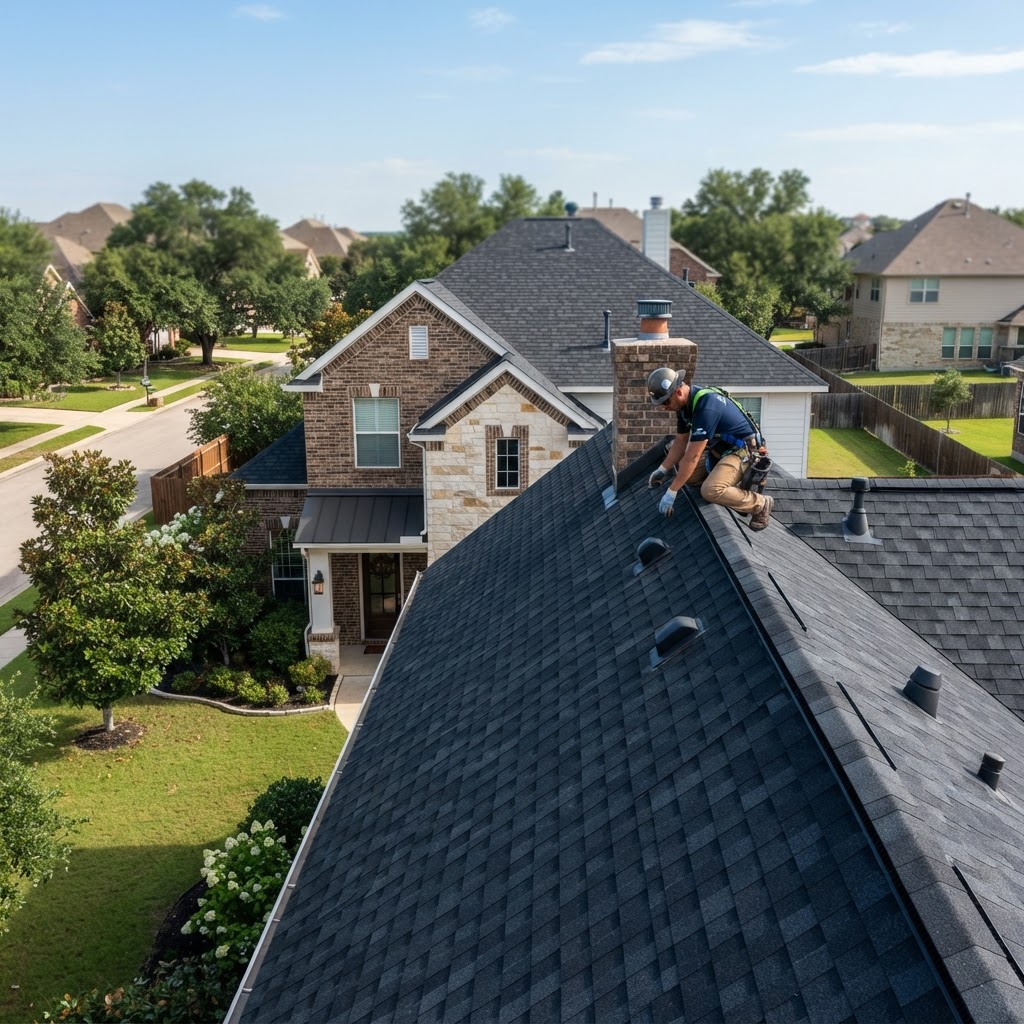
The Magnolia Homeowner's Seasonal Roof Checklist: What to Do Every 90 Days Before Texas Does It For You
Living in Magnolia means your roof faces UV-scorched summers, surprise hail from pop-up thunderstorms, tropical moisture from Gulf systems, and the occasional hard freeze — all in the same calendar year. Here's a quarter-by-quarter maintenance checklist built from 20+ years of climbing roofs across Montgomery County.
Living in Magnolia means your roof doesn't get a break. Between the brutal UV exposure of a Montgomery County summer, pop-up hailstorms that form over Lake Conroe and drop softball-sized stones without a single weather alert, the creeping humidity that rots decking from the inside out, and the kind of hard freezes that buckled flashing across the entire Texas Triangle in February 2021 — your roof is fighting a four-front war, twelve months a year.
Most roof inspection guides are written by people who have never actually stood on a 6:12 pitch in 98-degree heat trying to figure out whether a blister is cosmetic or catastrophic. This checklist is different. It's built from two decades of real inspections across Greater Houston's northwest suburbs — including Magnolia, Tomball, Spring, and Conroe — and it tells you exactly what to look for, when to look for it, and what it means when you find it.
Q1 (January–March): Post-Freeze, Pre-Storm Season Reset
The window between New Year's and the first serious thunderstorm of the year is the most underused maintenance opportunity Magnolia homeowners have. Here's how to use it.
1. Inspect all pipe boot flashings from the ground with binoculars. Neoprene pipe boots — the rubber collars around your plumbing vents — are the #1 source of roof leaks in Montgomery County homes built before 2010. They crack, degrade, and pull away from the pipe in freeze-thaw cycles. After any hard freeze (and especially after Winter Storm Uri in February 2021, which hammered Montgomery County), these fail silently for months before you see a water stain on your ceiling. Look for black collars that appear torn, separated, or no longer hugging the pipe tightly. Replacement boots run $15–$40 in materials; a contractor call is typically $150–$250. Do it now before June.
2. Walk your attic with a flashlight — slowly. In Magnolia's climate, attics see 160°F+ surface temperatures in summer and moisture infiltration from Gulf humidity year-round. In January, with cooler temps and less humidity, it's your best chance to spot daylight pinholes through the decking, soft spots in OSB panels, or the dark staining of mold colonies just getting started. Bring a phone and photograph anything suspicious. Soft decking (it'll feel spongy when you step on the joist-adjacent decking) almost always means a slow leak that's been going on longer than you think.
3. Clear all roof valleys of debris. Magnolia's tree canopy — primarily loblolly pine and water oak — drops debris year-round, but winter accumulation in roof valleys is especially damaging. Wet organic matter sitting in a valley holds moisture against your shingles and can accelerate granule loss in those zones by 2–3x. Use a soft-bristle broom or a leaf blower from the bottom of the valley upward. Never pressure wash a shingle roof.
Q2 (April–June): Prime Hail Season Prep
Montgomery County sits squarely in Texas's secondary hail corridor. The peak window runs April through June, when supercell thunderstorms track northeast out of the Hill Country and collide with Gulf moisture over the Conroe–Magnolia–Spring area. This is not a drill — Magnolia took a documented hail event in April 2023 with stones measured at 1.75" in diameter across the FM 1488 corridor.
4. Document your roof with photos before storm season. This sounds basic, but almost nobody does it, and it will save you thousands in a claims dispute. Walk your yard and photograph every roof plane, every flashing, every pipe boot, and every ridge cap. Date-stamp them. Insurance adjusters from carriers like State Farm, Allstate, and Farmers will sometimes argue that pre-existing granule loss was caused by the storm in question — your dated baseline photos kill that argument before it starts.
5. Check your gutters for granule accumulation. After any rainfall, check your downspout discharge. A tablespoon or two of granules in the gutter after a storm is normal. A cup or more, especially from a section of roof less than 15 years old, suggests accelerated granule loss — often from a prior hail event that was never properly assessed. Granule loss isn't just cosmetic: those granules are your shingles' UV protection. Once they're gone, the asphalt underneath oxidizes rapidly in Texas heat.
6. Trim any branches within 6 feet of your roof surface. This is especially important on the north and west sides of Magnolia homes, where oak limbs tend to overhang and act as moisture bridges. A limb doesn't have to fall to cause damage — it just has to rub your shingles in wind and abrade the granule surface over time. If you can't safely trim from a ladder, a local arborist visit typically runs $200–$500 and is well worth it.
Q3 (July–September): Hurricane Season + Peak UV Monitoring
July in Magnolia is roof-aging season. UV index readings regularly hit 10–11, and while you won't see the damage happening, asphalt shingles on south- and west-facing planes are taking a beating. Gulf tropical systems can also produce 60–80 mph wind gusts in Montgomery County even from storms making landfall far south — Hurricane Harvey (2017) and Tropical Storm Beta (2020) both caused significant roof damage well inland.
7. Check for lifted or cupped shingle edges on west-facing planes. Heat cycling causes asphalt shingles to expand and contract daily. On west-facing roof planes — which take the full force of afternoon sun — this can cause shingle edges to begin curling upward over time. Run your hand (carefully, from a ladder at the eave) under the bottom edge of a few shingles. If they flex upward more than about ½ inch, the sealant strip has likely released. These shingles won't blow off in calm weather, but a 50 mph tropical gust will rip them clean.
8. Inspect your ridge cap and hip caps after any tropical event. Ridge cap shingles are the most wind-vulnerable component on your roof. After any named storm or severe thunderstorm warning event, do a visual scan along your ridgeline. Missing or displaced ridge cap is a common source of interior water intrusion because the gap it leaves exposes your felt underlayment to direct rainfall. Ridge cap replacement is a straightforward repair — typically $3–$7 per linear foot in materials — but it has to happen before the next rain.
9. Confirm your attic ventilation is unobstructed. Here's an insight most homeowners miss: poor attic ventilation doesn't just make your AC work harder — it voids your shingle warranty. GAF's warranty on products like the Timberline HDZ requires a balanced 1:150 ventilation ratio. When soffit vents get blocked by insulation (a very common issue in blown-in attic insulation installations), attic temps spike and shingles age from the underside up. Check that your soffit vents — the small perforated strips along your eave overhangs — are not covered with insulation by looking from inside the attic with a flashlight.
Q4 (October–December): Wind-Down and Documentation Season
10. Schedule a professional inspection before year-end. Insurance policy renewal periods for many Montgomery County homeowners fall in Q4. Getting a documented professional roof inspection before renewal gives you leverage: if your carrier is trying to non-renew your policy over perceived roof condition, a current inspection report from a licensed contractor is often enough to push back. It also establishes a clean baseline for any winter weather events ahead.
11. Clean and re-caulk step flashings around chimneys and dormers. Step flashing — the L-shaped metal pieces that integrate your roof surface with vertical walls — is another silent failure point in Magnolia homes. Foundation movement (which is real and ongoing in Montgomery County's expansive clay soils) causes slight wall movement that works caulk loose over years. Use a product like NP1 polyurethane sealant, not standard paintable latex caulk, which cracks within 18 months in Texas temperature swings.
12. Check your attic insulation depth while you're up there. The DOE recommends R-38 to R-60 for Houston-area attics. Under-insulated attics accelerate shingle aging from below and drive up cooling costs significantly. While you're doing your Q4 attic walk, take a tape measure. If you're under 10 inches of blown-in insulation, it's worth a conversation with an insulation contractor before February.
One Thing Most Homeowners Get Wrong
The most common misconception we encounter across Magnolia and the FM 1488 corridor: waiting for an interior water stain to appear before taking roof damage seriously. By the time water shows up on your drywall, the leak has typically been traveling through decking, insulation, and framing for weeks — sometimes months. The real inspection window is before the stain, not after. Binoculars, a flashlight, and a 20-minute commitment twice a year will catch 80% of issues before they become emergency calls.
Your Next Step
If you work through this checklist and find something that concerns you — a suspicious boot, lifted ridge cap, soft decking, or anything you can't confidently identify — the right move is a no-obligation visual inspection before the next storm season window opens. The team at FairClaims Roofing & Construction offers free roof assessments for Magnolia-area homeowners, with no sales pressure attached. We'll tell you what we see, give you honest options, and let you make the call.
You can reach us directly or schedule online. RCAT License #03-0999.
Need a roof inspection?
FairClaims Roofing & Construction offers free inspections across the Texas Triangle.
Click to Call