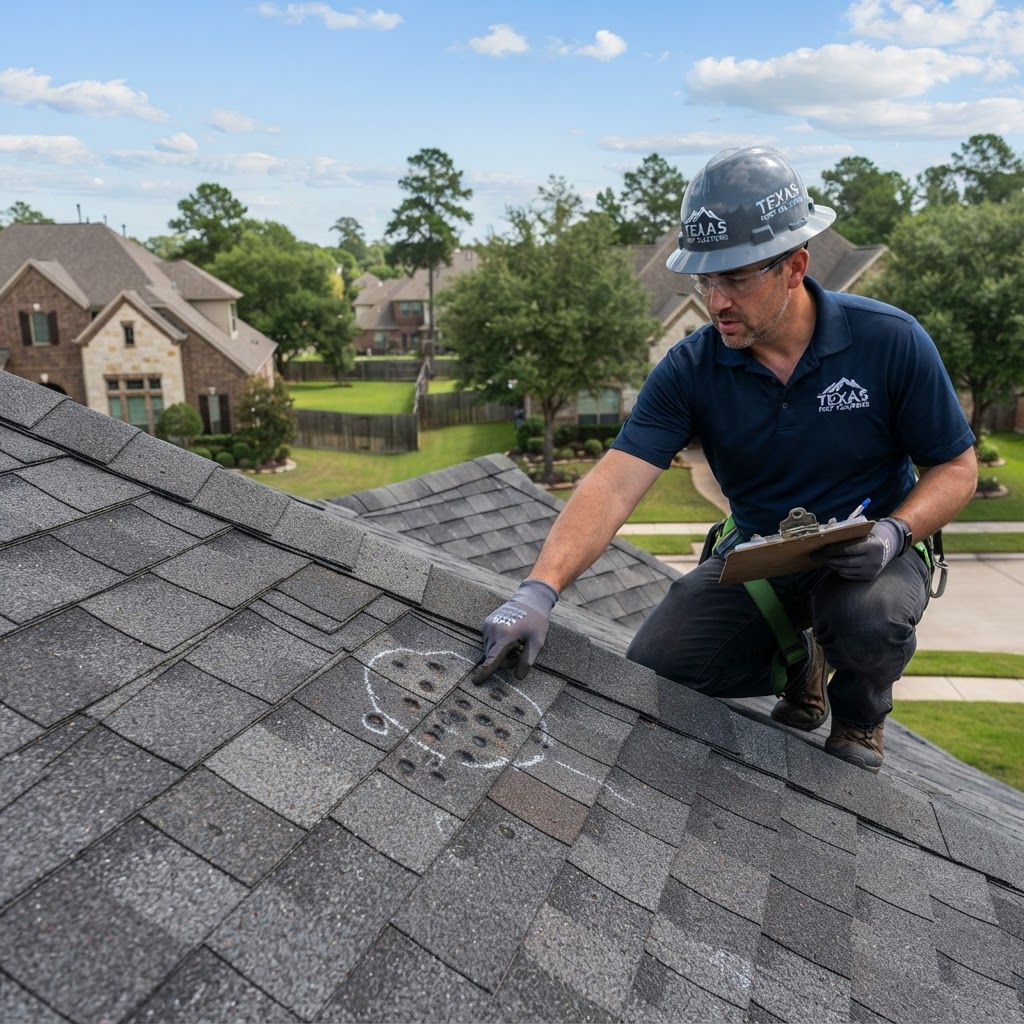
The 'My Roof Looks Fine' Myth: Why Tomball Homeowners Are Missing Hail Damage That's Already Voiding Their Insurance Coverage
After a hail storm rolls through Tomball, most homeowners walk outside, look up, and see nothing obviously wrong. No missing shingles, no holes, no water dripping from the ceiling. So they assume they're fine. They're usually not — and waiting to find out the hard way can cost them everything.
The Roof That Looks Fine (Until It Doesn't)
Every spring and early summer, we get calls from Tomball homeowners who are about six months too late. A storm rolled through — maybe it was one of those fast-moving pop-up hail events that comes up off the Gulf and tears through Harris and Montgomery counties before most people even check their weather app — and they walked outside afterward, looked at their roof from the driveway, saw no obvious damage, and went back inside.
Then six months later, they've got water stains on their ceiling. Or they file a claim and the insurance adjuster tells them the damage is "pre-existing" and the claim is denied. Or worse: they go to sell the house and the buyer's inspector flags a roof that's been functionally compromised for years.
This is the most dangerous myth in residential roofing: that visible damage is the only damage that matters.
It's not. And in Tomball specifically — where we sit in one of the most active hail corridors in the entire country — this misconception is costing homeowners thousands of dollars every year.
Why Hail Damage Is Almost Always Invisible From the Ground
Let's talk about what hail actually does to a modern asphalt shingle roof, because this is where most homeowners (and frankly, a lot of inexperienced contractors) get it wrong.
When a hailstone — even a relatively modest 1-inch stone — hits a GAF Timberline HDZ or an Owens Corning Duration shingle, it doesn't punch a hole. What it does is fracture the fiberglass mat beneath the surface granules and dislodge the granules themselves. From the ground, the shingle looks intact. From the attic, it looks dry. But the structural integrity of that shingle is gone.
Here's the part that surprises most people: that fractured mat is now a moisture pathway. Not today. Not next month. But over the next 12 to 24 months, as Tomball's brutal summer heat cycles through 95-degree days and UV radiation continues degrading the already-compromised asphalt, that fracture expands. Water finds it during the next storm season. By the time you see a ceiling stain, you're dealing with decking rot, possible mold in the attic, and a claim situation that's become dramatically more complicated.
On top of that, the granule loss accelerates UV degradation across the entire shingle surface. What was a 30-year architectural shingle is now functionally aging at twice the rate.
The Insurance Timing Problem Unique to Texas
Texas insurance law gives homeowners a one-year window to file a hail or wind damage claim from the date of the storm event (as of recent legislative changes — previously it was two years, and some older policies may still reflect different terms, so read your policy carefully). That window sounds generous. It isn't, once you factor in how hail damage actually reveals itself.
Here's what we see constantly in the Tomball and Spring/Klein area:
- Storm hits in April or May (peak Texas hail season, typically March through June)
- Homeowner sees no visible damage, files nothing
- Interior water intrusion shows up in September or October after summer heat has expanded the damage
- Homeowner calls their insurance company
- Adjuster inspects, notes granule loss consistent with hail impact — but also notes "weathering and wear" as contributing factors
- Claim gets partially denied or reduced, and the homeowner has no documentation of the original storm damage
If that same homeowner had gotten a professional roof inspection within 30 to 60 days of the storm, they would have documentation: photos, measurements of hail strikes per square foot, identified impact points on soft metals (gutters, vent caps, AC shrouds — the real diagnostic gold standard), and a timestamped report tied to a specific storm date.
That documentation is what turns a disputed claim into a paid claim.
Why Tomball's Geography Makes This Worse
Tomball sits at an interesting meteorological intersection. We're far enough inland to catch the organized severe weather systems that drop down from the DFW corridor, but we're also close enough to the Gulf to get the moisture-laden pop-up storms that form fast and hit hard. The April 2021 hail event that hit parts of Tomball, Cypress, and Magnolia dropped stones up to 2.5 inches in some areas — the kind of event that absolutely destroys roofs while leaving them visually intact to the untrained eye.
Beyond hail, Tomball homes face a combination of stressors that compound damage over time:
- Foundation movement from our expansive clay soils causes subtle shifts at roof penetrations — pipe boots, chimney flashing, skylight curbs — creating slow leak pathways that get mistaken for storm damage (or vice versa)
- Attic humidity in our climate creates condensation issues that look like roof leaks but aren't, which muddies claim documentation
- Summer UV intensity means a shingle compromised by a spring hail event degrades dramatically faster here than it would in, say, Colorado
These compounding factors are exactly why a post-storm inspection by someone who actually knows what they're looking at isn't optional — it's financial self-defense.
What a Real Post-Storm Inspection Actually Involves
Not all inspections are equal, and this matters. A legitimate post-storm inspection should include:
-
Soft metal inspection first — gutters, downspout elbows, AC condenser fins, painted flashing. Hailstones leave divots in soft metal that are undeniable, datable evidence. If there are no soft metal impacts, there's reason to question whether hail actually hit your property (hail is hyperlocal — your neighbor two streets over may have taken a direct hit while you didn't).
-
Granule displacement mapping — random granule loss is weathering; clustered, directional granule loss with exposed mat is hail impact. These look different if you know what you're looking for.
-
Fiberglass mat integrity check — on shingles with suspected impacts, gentle pressure reveals whether the mat beneath is fractured or intact.
-
Ridge cap and hip examination — these elevated areas catch the most direct hail exposure and show damage first.
-
Attic inspection — checking for daylight penetration, moisture staining on decking, and proper ventilation function.
At FairClaims Roofing & Construction, we document every one of these elements with timestamped photography before we ever have a conversation about scope of work. That documentation belongs to the homeowner regardless of what happens next.
The Real Cost of Waiting
A straightforward hail damage replacement on a 2,000-square-foot Tomball home typically runs $12,000 to $18,000 depending on pitch, complexity, and material. With a valid insurance claim and a $2,500 deductible, your out-of-pocket is manageable.
A denied claim because damage is now classified as "wear and tear" due to delayed reporting? That's the full replacement cost coming out of your pocket — plus whatever interior repairs the undiscovered leak has racked up.
The math on a timely inspection is straightforward.
What to Do After the Next Tomball Storm
You don't need to panic after every storm. But if your area received confirmed hail (the Harris County/Montgomery County line sees several significant events per year — NOAA's Storm Events Database is public and searchable by county), take one concrete step:
Schedule a professional roof inspection within 45 days of the storm event. Not a roofing company that knocks on your door the next morning (treat that with caution), but a licensed Texas contractor who will give you written documentation of findings with no pressure attached.
That documentation is your protection — whether the roof is fine, needs minor repairs, or warrants a full insurance claim. Knowledge is always cheaper than surprise.
If you're in the Tomball, Cypress, Magnolia, or Spring area and want an honest assessment after recent storm activity, reach out to our team for a no-obligation inspection. We'll tell you exactly what we find — including if your roof is genuinely fine.
Need a roof inspection?
FairClaims Roofing & Construction offers free inspections across the Texas Triangle.
Click to Call