Your Roof Just Took a San Antonio Hailstorm: Here's Exactly What Happens Next (Hour by Hour)
A real-world walkthrough of what to do after hail hits your San Antonio home — from the first inspection to the final insurance check. Learn what most homeowners get wrong, what adjusters look for, and how to avoid the most expensive mistakes.
It's 4:47 PM and the Storm Just Passed
You're standing in your driveway in Alamo Ranch or Stone Oak, looking at dented gutters, a cracked skylight lens, and dime-sized dents in your AC condenser fins. The sky has gone weirdly quiet. Your phone is already blowing up with texts from neighbors asking if you got hit.
This is the moment most homeowners get wrong. What you do in the next 24–72 hours will directly affect whether your insurance claim pays out fully, partially, or gets denied. Let's walk through it the right way.
Why San Antonio Hail Is Uniquely Dangerous for Roofs
San Antonio sits in one of the most active hail corridors in the country. The convergence of Gulf moisture, dry air from the west, and the instability created by the Balcones Escarpment means pop-up supercells form faster here than almost anywhere in Texas. The March–May window is the most active, but September storms — like the kind that rolled through the I-10 corridor in 2019 and again in late 2023 — catch homeowners completely off guard because they assume hail season is over.
It isn't.
What makes it worse: San Antonio's intense UV index (routinely above 10 from May through September) pre-ages asphalt shingles faster than in Houston or DFW. By the time a hailstorm hits a 10-year-old roof in the Hill Country suburbs, the granule adhesion is already compromised. The same 1.5-inch hail that bounces off a newer GAF Timberline HDZ shingle in Frisco will crater a heat-fatigued 3-tab shingle in Helotes.
Hour 1–3: Document Before You Touch Anything
Do not go on your roof. We say this every time and homeowners still do it, usually barefoot or in sandals, on wet decking. Falls are the number one post-storm injury we see.
What you should do immediately:
- Walk your property perimeter and photograph everything at ground level. Dents in gutters, downspout damage, window screens with impact marks, fence caps, patio furniture — all of this establishes the storm hit hard enough to cause damage.
- Check your AC unit. Condenser fin damage is one of the best proxies adjusters use to confirm hail size. If your Carrier or Lennox unit looks like it was hit with a ball-peen hammer, document it.
- Look at soft metals first. Aluminum step flashing around chimneys, lead pipe boots, and painted metal vents dent easily and photograph clearly. These are your best evidence.
- Screenshot a weather report or radar replay. Apps like RadarScope let you pull historical storm data. Save the timestamp and storm track. Insurance companies occasionally push back claiming hail "didn't reach your address" — radar data shuts that down fast.
Hour 3–24: Call a Roofer Before You Call Your Insurance Company
This surprises most homeowners. The conventional wisdom is to call your insurer first. Here's why that order can hurt you:
When you call your insurance company, they will schedule a desk adjuster or a field adjuster. Many adjusters — especially after a widespread San Antonio event — are third-party catastrophe adjusters brought in from out of state. They may have never seen a Texas roof, don't understand how heat cycling affects granule loss, and are working 15-20 inspections a day. They're not trying to cheat you, but they are moving fast.
If you have a qualified roofer on-site during the adjuster's inspection, that changes the dynamic entirely. The roofer can point out marginal damage the adjuster might otherwise mark as "wear and tear" — things like bruised shingles that look fine from 20 feet but show spatter marks and fractured mat when you're holding them.
Get your inspection done first, then file your claim, then request the adjuster visit and have your contractor present.
What a Real Hail Inspection Looks Like
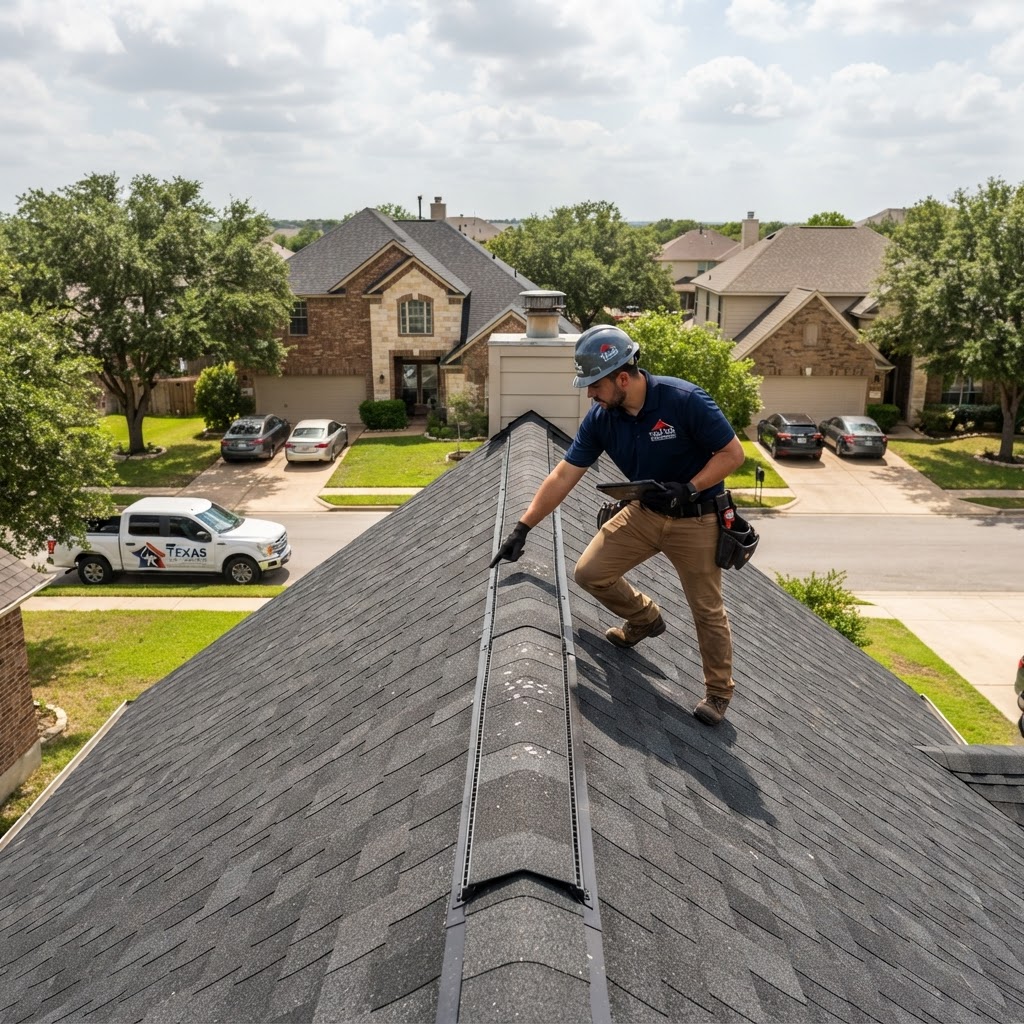
A thorough post-hail inspection isn't a 10-minute walk across the ridge. Here's what we actually do:
- Four-quadrant testing — Hail falls at an angle. We check north, south, east, and west-facing slopes separately because damage distribution tells us wind direction and impact energy.
- Granule displacement mapping — We look for "bruises" where the mat is exposed, not just surface granule loss. UV-degraded shingles will show granule loss that predates the storm; storm damage has clean, fresh spatter patterns around impact craters.
- Flashing inspection — San Antonio's expansive clay soils cause foundation movement that stresses step flashing and counter-flashing at chimneys and dormers. A hailstorm is often the event that finally opens a gap that was slowly forming for years. We document both the storm damage and any pre-existing movement cracking separately.
- Attic inspection — We check for daylight penetration, moisture staining on the decking, and whether the ridge vent system is intact. In San Antonio's humidity, even a small hail breach can cause mold growth in an attic within 30–60 days if not addressed.
- Satellite dish and solar panel mounts — Increasingly common in suburban San Antonio neighborhoods. Hail can crack conduit seals and compromise waterproofing around mounts without visibly damaging the panels themselves.
The Insurance Claim: What to Expect and What to Push Back On
Most standard homeowner policies in Texas (HO-3 form) cover hail as a named peril. Your main variables are:
- Deductible type — Many Texas policies switched to percentage-based hail deductibles after the 2016–2019 claim surge. A 1% deductible on a $400,000 home in Boerne is $4,000 out of pocket before your coverage kicks in. Know your number before you file.
- ACV vs. RCV — Actual Cash Value policies depreciate your roof's age against the payout. A 15-year-old roof might only net you 40% of replacement cost. Replacement Cost Value policies pay full replacement minus your deductible. If you have ACV, you can often purchase an endorsement to upgrade — ask your agent before the next storm season.
- Supplement claims — After the initial scope of work is written, contractors routinely find additional damage during tear-off (rotted decking, deteriorated pipe boot flashings, improper previous repairs). A legitimate supplement request is standard. If an adjuster tells you supplements are unusual, that's a red flag.
State Farm, Allstate, and USAA all handle Texas hail claims somewhat differently in terms of preferred vendor networks and documentation requirements. Work with a contractor who has handled claims with your specific carrier before.
The Repair Itself: What Goes on Your Roof Matters
Not all replacement shingles perform equally under San Antonio conditions. If you're going through a full replacement, push for a product with a Class 4 impact rating — the highest available. GAF's Timberline ArmorShield II, for example, carries a Class 4 UL 2218 rating and can qualify for a discount with many Texas carriers (check with your agent — savings of 20–30% on your wind/hail premium are common and often not automatically applied).
For flat or low-slope sections — common on Hill Country contemporary homes — TPO membranes with reinforced seams hold up significantly better than older modified bitumen systems under hail impact.
Make sure whoever does your work pulls a permit with the City of San Antonio or the relevant municipality. Unpermitted roofing work can void your homeowner's warranty and create problems at resale.
One Thing Most Homeowners Never Think About
Here's the insight that surprises nearly everyone we tell: your neighbor's roof is your best evidence.
If three houses on your street had confirmed hail damage and your adjuster is calling yours "maintenance issues," that's an inconsistency worth challenging. We've helped homeowners successfully re-open claims by documenting the damage pattern across an entire street and showing the adjuster that every roof of the same age and exposure showed identical impact patterns.
Insurance adjusting is not an exact science. Politely persistent documentation wins.
Your Next Step
If your San Antonio home took hail in the last 12 months and you haven't had a professional inspection — not a storm chaser who knocked on your door, but a licensed, local contractor — schedule one before the next storm season opens. FairClaims Roofing & Construction offers free post-storm inspections with no obligation, and our team carries RCAT license #03-0999 and GAF Master Elite® certification.
A 45-minute roof inspection costs you nothing. Missing a legitimate claim or letting a hail breach quietly rot your decking all winter costs considerably more.
Need a roof inspection?
FairClaims Roofing & Construction offers free inspections across the Texas Triangle.
Click to Call